
In short
- Metabolism includes the chemical processes of breaking substances down and building them up.
- Daily energy expenditure includes resting functions, processing food and physical activity.
- Energy use is expressed in units such as kcal, and comparisons need context about body size, composition, age, sex and activity.
- A GP can assess symptoms and arrange blood tests for suspected thyroid problems.
In this article
Metabolism is the collective name for the chemical processes that keep your body alive. It includes breaking substances down and building substances up, rather than a single process in one organ. 1 Your body uses energy for essential functions, growth and repair, digestion and movement. 2
What are catabolism and anabolism?
Catabolism means breaking substances down; anabolism means building substances up. These are the two broad parts of metabolism. 1
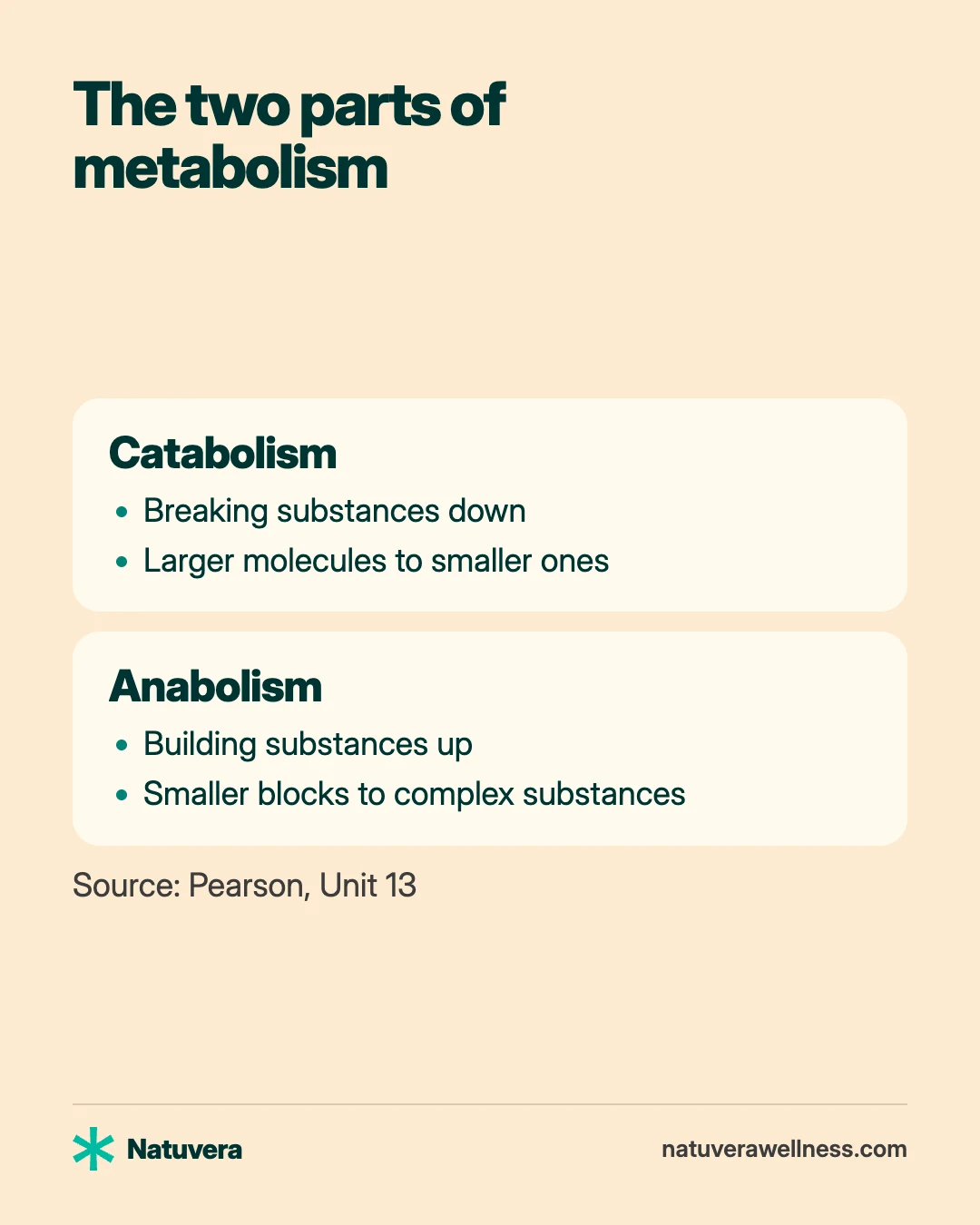
The names describe the direction of chemical reactions. In catabolism, larger molecules are broken into smaller ones. In anabolism, smaller building blocks are assembled into more complex substances. Both belong within the meaning of metabolism, so defining the word only as the breakdown of food leaves out its building processes. 1
You may encounter the adjective “metabolic” alongside the noun “metabolism”. It simply refers to these processes. A metabolic rate is a different kind of description: it expresses energy use over time. Keeping the process and its rate distinct makes the terminology easier to follow. 1
The sections below explain how these terms are used.
Where does your body's energy go?
Daily energy expenditure includes the energy used at rest, the cost of processing food and physical activity. These are different parts of the day's total, rather than interchangeable names for metabolism. The Scientific Advisory Committee on Nutrition (SACN) separates them in its report on energy requirements. 3
Essential functions at rest
Your organs need energy even when you are lying still. The heart, lungs and brain continue their work without a workout or a walk. Energy is also needed for tissue growth and repair. These basic demands explain why being physically inactive does not mean that your body uses no energy. 2
Basal metabolic rate, usually shortened to BMR, is a standardised measurement under particular resting conditions. You are awake, comfortably warm and resting after food has been digested and absorbed. For most people, it is the largest component of daily energy expenditure. 3
Processing food
Eating, digesting, absorbing and processing food also have an energy cost. This is called the thermic effect of food, or TEF. It belongs in the overall energy account, alongside resting expenditure and activity. The term describes a physiological cost; it is not a recommendation to choose a particular food. 3
Physical activity
Activity includes everyday movement as well as planned exercise. Walking to the shops, doing household tasks and playing with children all involve movement. A gym session is only one example. The BDA-hosted patient resource distinguishes physical activity from exercise, which is its planned and structured subset. 2
What the research says about activity and energy use is covered in our guide to metabolism and energy use.
Why do people use different amounts of energy?
Body size, body composition, age, sex and activity all matter when interpreting energy expenditure. A result needs that context before it can sensibly be compared with someone else's. 3
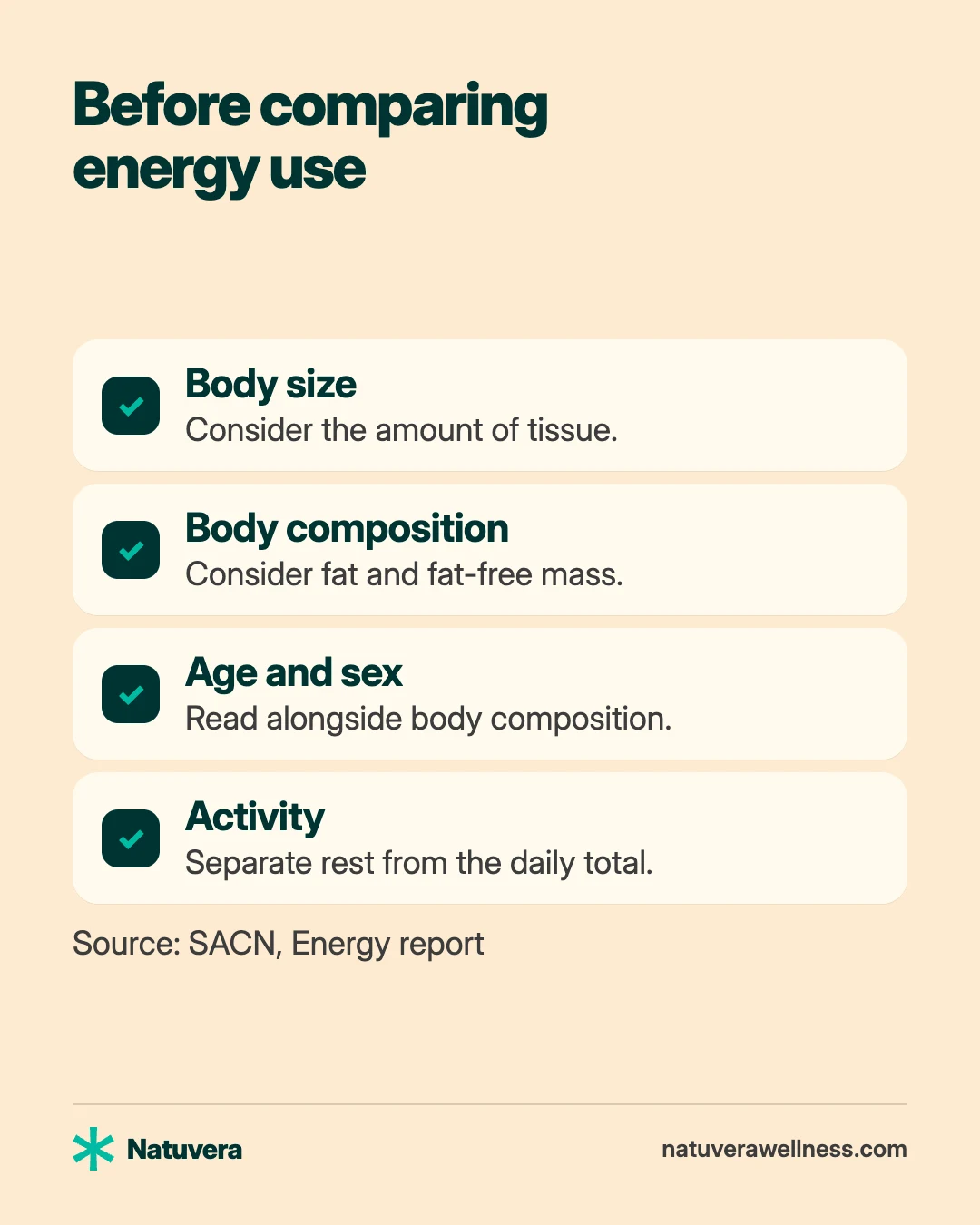
Body composition means what your body is made of. SACN distinguishes fat mass from fat-free mass, which includes muscle, bone, skin and organs. Differences in fat-free mass explain much of the variation in BMR between people after body size has been taken into account. Muscle is part of the explanation, alongside other tissues. 3
Larger people generally have more tissue to maintain. SACN also explains that much of the difference associated with age and sex is accounted for by body composition. These are descriptions of measured energy requirements, rather than instructions to alter your body. 3
Daily movement provides another part of the context. Someone's activity expenditure concerns what they do across the day, whereas BMR is assessed under resting conditions. A comparison of total daily expenditure cannot automatically be read as a comparison of BMR. 3
Age needs its own careful explanation. The separate article on whether metabolism slows with age examines the life-course evidence and what researchers mean when they adjust for body composition.
How is metabolism measured in calories and kcal?
Calories are units of energy. In food information, “calories” usually refers to kilocalories, written as kcal. You will also see kilojoules, written as kJ. The NHS explains these labels in its guidance on understanding calories. 4
Energy expenditure reported in kcal per day describes an amount of energy used over that period. It does not count individual chemical reactions or give every aspect of metabolism a single score. BMR and total daily expenditure can use the same unit while referring to different measurements. 3
Measurements and estimates also differ. SACN describes indirect calorimetry, which uses oxygen consumption and/or carbon dioxide production to calculate energy expenditure. Prediction equations instead estimate BMR from characteristics such as body size, age and sex. An equation's output is therefore an estimate, rather than a direct measurement of your own expenditure. 3
Reading a calorie label tells you about the energy in that food or drink. It does not measure your BMR. Likewise, the NHS's general calorie guidance recognises that needs differ with age, height, weight and activity. A population guide should not be read as your personal laboratory result. 4
What can a GP check if thyroid disease is suspected?
Thyroid status can change resting energy expenditure. SACN describes higher resting expenditure with an overactive thyroid and lower resting expenditure with an underactive thyroid. These are medical conditions that require assessment. 3
Common questions
What is metabolism?
Metabolism is the collective name for the chemical processes that keep the body alive. It includes catabolism, which breaks substances down, and anabolism, which builds them up.
How does metabolism work?
Its chemical processes include breakdown and building. Energy is used for essential functions at rest, tissue growth and repair, processing food and physical activity.
How is metabolism measured?
Energy expenditure can be expressed in kcal per day. Basal metabolic rate describes expenditure under standardised resting conditions, while total daily expenditure also includes food processing and activity. Equations estimate expenditure; laboratory methods can measure it.
General information about food and health, not medical advice. If you have symptoms or a medical condition, take any medicine or are pregnant, speak to your GP or pharmacist.
References
- Pearson. BTEC National Sport and Exercise Science Student Book: Unit 13, Nutrition for Sport and Exercise Performance. Publication year not stated. Read the source (accessed 14 November 2026).
- Cheshire and Wirral Partnership Dietitians; hosted by the British Dietetic Association. Metabolism & Physical Activity. 2020. Read the source (accessed 14 November 2026).
- Scientific Advisory Committee on Nutrition. Dietary Reference Values for Energy. 2011. Read the source (accessed 14 November 2026).
- NHS. Understanding calories. Publication year not stated. Read the source (accessed 14 November 2026).
- NHS. Underactive thyroid (hypothyroidism). Publication year not stated. Read the source (accessed 14 November 2026).
- NHS. Overactive thyroid (hyperthyroidism). Publication year not stated. Read the source (accessed 14 November 2026).