In short
- The study found a broadly stable adult period after adjustment for body composition.
- Its age bands describe a population pattern rather than an individual diagnosis.
- NHS guidance for older adults includes aerobic activity, strength, balance and flexibility.
In this article
Metabolism does not appear to slow steadily throughout adult life. A major study published in 2021 found that daily energy expenditure adjusted for body composition was broadly stable from about 20 to 60 years, then declined in older adults. The important qualification is “adjusted”: the result separates the age pattern from differences in body size and composition. 1
What did the 2021 study measure?
Herman Pontzer and colleagues analysed energy expenditure data from 6,421 people across 29 countries, ranging from 8 days to 95 years old. The researchers used measurements made with doubly labelled water, a method for estimating total energy expenditure during daily life. Basal expenditure measurements were also available for 2,008 of them. 1
Total daily expenditure means the energy used across the day. Basal expenditure concerns energy used under standardised resting conditions. They are related measurements, but they answer different questions. SACN’s report separates the energy used at rest from physical activity and the energy cost of processing food. 2
What happened in each age band?
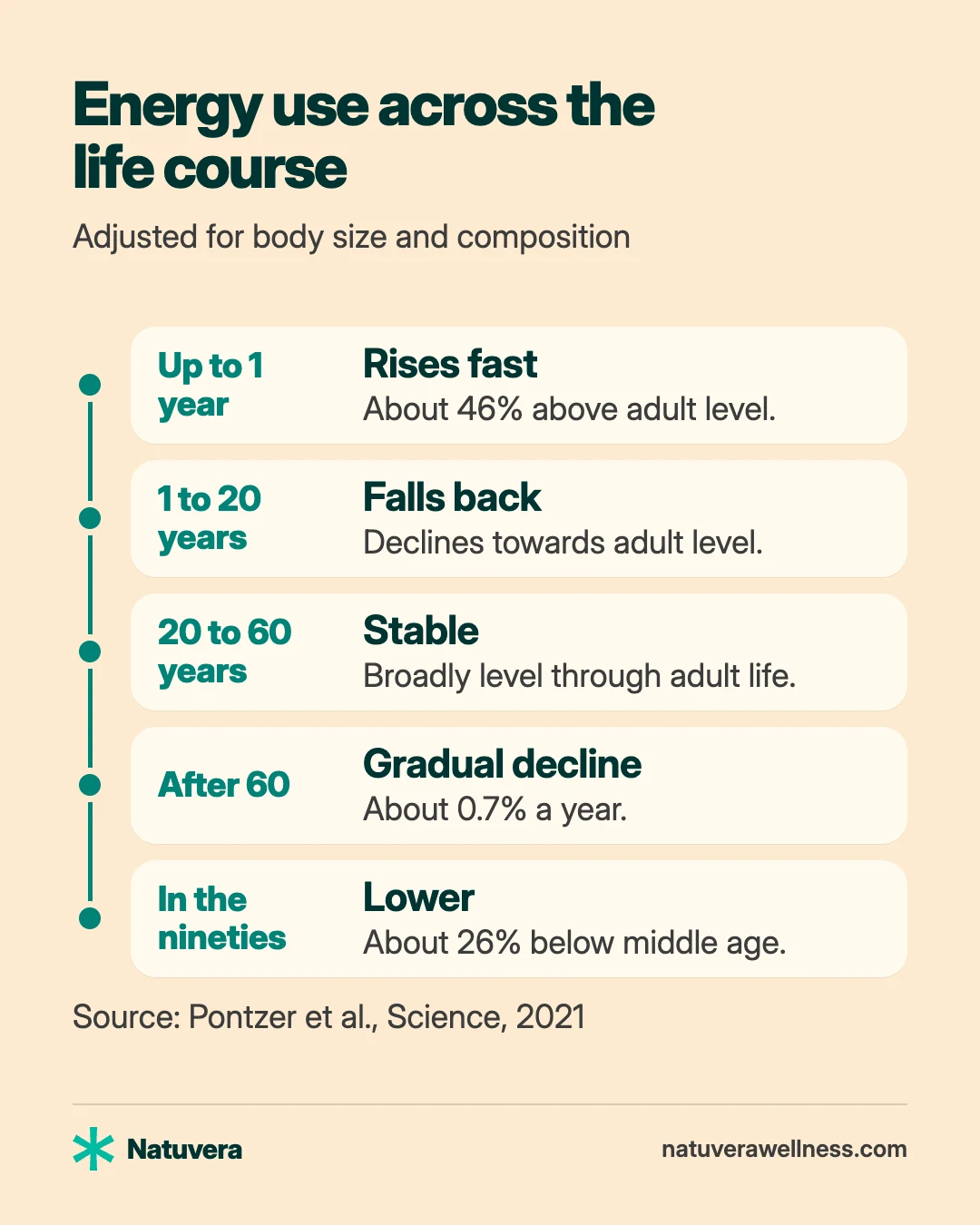
The paper identified four broad phases: a rapid rise in adjusted expenditure during the first year, a decline towards adult levels through childhood and adolescence, a stable adult period and a later-life decline. The figure below summarises the four phases. 1
Birth to about 1 year
In the first month, size-adjusted total expenditure was near adult levels. It then rose rapidly, to about 46% above adult values at around 1 year. 1
About 1 to 20 years
Adjusted expenditure gradually declined towards adult levels. Absolute energy expenditure could still increase as children grew: a growing body and an age-adjusted comparison are different measurements. The paper did not identify an extra puberty-related rise in adjusted total or basal expenditure. 1
About 20 to 60 years
The broad adult pattern was stable, around the 100% adult reference. This is the finding behind headlines questioning a routine slowdown in early or middle adulthood. 1
After about 60 years
Adjusted total expenditure declined by around 0.7% a year in the analysis. For participants in their nineties it was about 26% below middle-aged adult values, equivalent to approximately 74% of that reference. 1
The boundaries were estimates. The segmented analysis placed the change point for adjusted total expenditure at 63 years, with a confidence interval from 60.1 to 65.9 years. The paper was less precise about the basal expenditure change point because there were relatively few basal measurements in the relevant middle-age range. A birthday is not a universal switch. 1
What does “adjusted for body composition” mean?
A larger body generally has more tissue to maintain. Fat-free mass includes organs, muscle, bone and skin, and its amount influences resting energy use. SACN explains why comparing expenditure without considering body size and composition can obscure the question being asked. 2
The life-course researchers accounted for fat-free mass and fat mass when examining the age pattern. This was a statistical adjustment, rather than simply dividing daily expenditure by body mass. Their analysis could therefore ask how expenditure differed relative to what would be expected for a person’s composition. 1
Where do muscle and everyday activity fit?
Muscle strength, daily movement and physical function remain relevant as people get older. NHS guidance for adults aged 65 and over includes activity every day, less uninterrupted sitting, and activities for strength, balance and flexibility on at least 2 days a week. It provides practical advice rather than a forecast of metabolic change. 3
The weekly aerobic target is at least 150 minutes of moderate activity, or 75 minutes of vigorous activity for people who are already active, or a combination. NHS examples of strengthening activities include resistance bands, lifting weights and heavy gardening. Strengthening activity is not always aerobic, so the two parts of the guidance should both be considered. 3
Start from your current abilities. The NHS advises speaking to a GP first if you have not exercised for some time or have medical conditions or concerns. If you have fallen or worry about falling, its guidance highlights strength, balance and flexibility. This advice remains useful regardless of where your age sits on the study’s curve. 3
When should you see a GP?
For the wider distinction between resting expenditure, movement and food research, see the guide to metabolism and energy use. The separate explainer on what chromium does in the body covers authorised nutrient wording, food sources and intake guidance.
Common questions
At what age does metabolism slow down?
The study found a broadly stable adjusted adult period from about 20 to 60 years, followed by a later-life decline. Its age boundaries are estimates, not a universal change on a birthday.
Does metabolism slow in your thirties?
The study did not find a separate population-wide slowdown in that decade after adjustment for body composition. Individual circumstances and daily activity can still change.
Did the study measure the same people throughout life?
It analysed measurements from people at different ages. It was not a decades-long record of every participant, so its curve is not an individual forecast.
General information about food and health, not medical advice. If you have symptoms or a medical condition, take any medicine or are pregnant, speak to your GP or pharmacist.
References
- Science; author manuscript hosted by University of California eScholarship. Daily energy expenditure through the human life course. 2021. Read the source (accessed 12 November 2026).
- Scientific Advisory Committee on Nutrition. Dietary Reference Values for Energy. 2011. Read the source (accessed 12 November 2026).
- NHS. Physical activity guidelines for older adults. Publication year not stated. Read the source (accessed 12 November 2026).
- NHS. Underactive thyroid (hypothyroidism). Publication year not stated. Read the source (accessed 12 November 2026).