
In short
- Basal metabolic rate and total daily energy expenditure describe different measurements.
- Body size, body composition, activity and age affect the interpretation of energy use.
- A 2020 review linked strength training with a higher resting metabolic rate; NHS guidance sets weekly activity targets.
In this article
- What are metabolism and basal metabolic rate?
- Why do people use different amounts of energy?
- What has research measured for activity and strength training?
- Does sleep change the measurements?
- What is the energy cost of digesting food?
- Which nutrients have authorised claims about metabolism?
- When should you speak to a GP?
- Common questions
- References
The part of your daily energy use you can change most is movement, and a 2020 review found that resistance (strength) training was linked to a higher resting metabolic rate than control conditions. 1 Body size, body composition and age also shape how much energy you use. 2 No food supplement is authorised to claim that it can boost metabolism: the Great Britain nutrition and health claims register lists no such claim. 3
What are metabolism and basal metabolic rate?
Basal metabolic rate (BMR) represents the metabolic activity of cells and tissues and the functions essential for life. It is a standardised measurement taken while someone is awake, resting, comfortably warm and no longer digesting a meal. It describes essential activity in cells and tissues, rather than everything the person does that day. 2
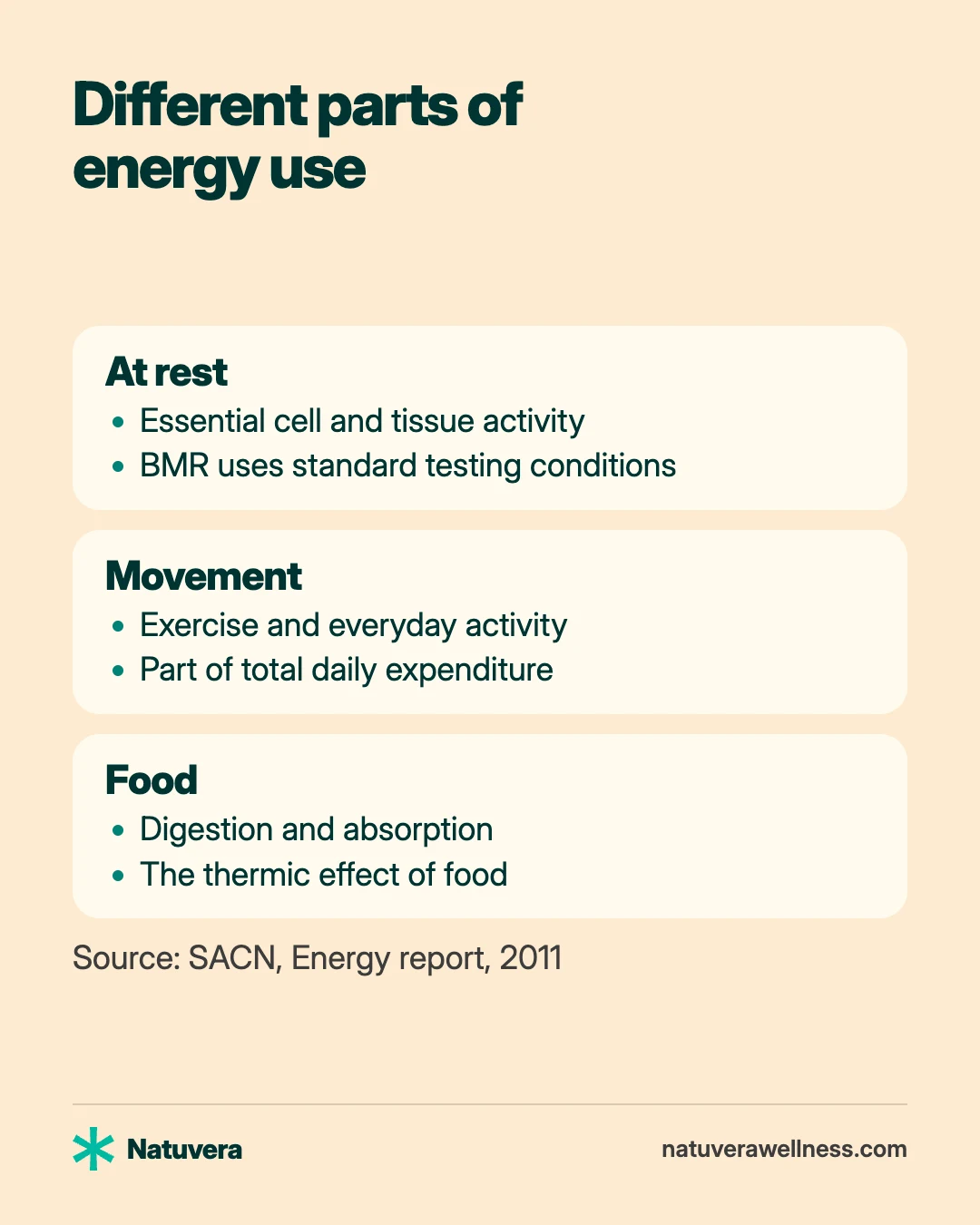
Total daily energy expenditure includes resting functions, physical activity and the energy cost of processing food. Walking to the shops belongs in the activity component. The energy needed to digest and absorb lunch belongs in the thermic effect of food. Neither should be mistaken for a permanent change in BMR. 2
Research often reports resting metabolic rate (RMR). It is often used interchangeably with BMR, but when it is not measured under the standard conditions it can include extra activity, such as digesting a meal, so it reads higher. 2
Why do people use different amounts of energy?
Body size and composition explain much of the variation. A larger body generally has more tissue to maintain, while fat-free mass includes organs, muscle, bone and skin. Muscle is part of this picture, rather than the only tissue that matters. SACN’s energy report distinguishes these factors when explaining differences between people’s requirements. 2
Age needs equally careful interpretation. In a large life-course study, energy expenditure adjusted for body composition was broadly stable between about 20 and 60 years, before declining in later life. That is a population pattern, not a measurement of any individual reader. 4 The separate article on whether metabolism slows with age explains the age bands and the limits of the study.
What has research measured for activity and strength training?
Physical activity uses energy during movement, but this is different from asking whether a training programme changes energy expenditure at rest. A systematic review published in 2020 examined resting metabolic rate after exercise interventions, rather than the immediate energy cost of a single workout. 1
The review included 22 studies in its qualitative assessment and 18 in its meta-analysis. The resistance exercise comparison recorded a higher average resting metabolic rate than control conditions. The aerobic exercise comparison did not show a statistically clear difference. Methods varied and the authors identified a high risk of bias within the included studies. 1
The participant exclusions also matter: the review excluded older adults aged 65 or over, pregnant and breastfeeding women, postmenopausal women and people with conditions affecting resting metabolic rate. 1
For everyday decisions, NHS activity guidance is more useful than attempting to reproduce a laboratory result. Adults aged 19 to 64 are advised to aim for at least 150 minutes of moderate activity a week, or 75 minutes of vigorous activity, alongside strengthening activities on at least 2 days. Break up long periods of sitting and choose activity appropriate to your fitness. 5
If you have not exercised for some time or have a medical condition or concerns, speak to your GP before starting. 5
Does sleep change the measurements?
A small randomised crossover study compared short and habitual sleep conditions in 10 healthy women. After 3 nights with 4 or 8 hours in bed per night, researchers measured resting energy expenditure and the response to a test meal using whole-room indirect calorimetry. They found no statistically significant difference between conditions in average resting expenditure or the thermic effect of food. 6
The practical reason to address poor sleep is how it affects daily life. The NHS says adults need an average of 7 to 9 hours, with individual variation. Its advice includes a consistent waking time, a quiet bedroom and time to relax before bed. 7
What is the energy cost of digesting food?
The thermic effect of food is the energy used in eating, digesting, absorbing and processing nutrients. SACN’s report commonly assumes a value equivalent to around 10% of energy intake, while explaining that the amount varies with meal size and composition. This is an estimate used in understanding energy expenditure, rather than an exact percentage for every meal. 2
Which nutrients have authorised claims about metabolism?
The GB register authorises claims about normal metabolism for some nutrients. Two examples are “Zinc contributes to normal macronutrient metabolism” and “Chromium contributes to normal macronutrient metabolism”. The zinc claim may be used only for food that is at least a source of zinc, and the chromium claim only for food that is at least a source of trivalent chromium, in each case as defined by the source claims in the Annex to Regulation (EC) No 1924/2006. 3 For the chromium claims in full, read what chromium does in the body.
When should you speak to a GP?
If you have a medical condition, take medicines, are pregnant or are breastfeeding and are considering a supplement, speak to your GP or pharmacist.
Common questions
Can I increase my metabolism?
Physical activity is the part of daily energy use you can change most. A 2020 review linked resistance training with a higher resting metabolic rate than control conditions, although the included studies varied in method.
Does strength training change resting metabolic rate?
A systematic review recorded a higher average resting metabolic rate in resistance exercise comparisons. The studies had varied methods and a high risk of bias, so the result is not a personal forecast.
How much exercise should adults do each week?
The NHS advises at least 150 minutes of moderate activity or 75 minutes of vigorous activity a week, plus strengthening activities on at least 2 days.
General information about food and health, not medical advice. If you have symptoms or a medical condition, take any medicine or are pregnant, speak to your GP or pharmacist.
References
- Journal of Sports Sciences. The effect of exercise interventions on resting metabolic rate: A systematic review and meta-analysis. 2020. Read the source (accessed 12 November 2026).
- Scientific Advisory Committee on Nutrition. Dietary Reference Values for Energy. 2011. Read the source (accessed 12 November 2026).
- Department of Health and Social Care. Great Britain nutrition and health claims (NHC) register. 2026. Read the source (accessed 12 November 2026).
- Science; author manuscript hosted by University of California eScholarship. Daily energy expenditure through the human life course. 2021. Read the source (accessed 12 November 2026).
- NHS. Physical activity guidelines for adults aged 19 to 64. Publication year not stated. Read the source (accessed 12 November 2026).
- International Journal of Obesity. Postprandial thermogenesis and substrate oxidation are unaffected by sleep restriction. 2014. Read the source (accessed 12 November 2026).
- NHS. Insomnia. Publication year not stated. Read the source (accessed 12 November 2026).
- NHS. Underactive thyroid (hypothyroidism). Publication year not stated. Read the source (accessed 12 November 2026).