In short
- Digestive enzymes made by the body act on different food components.
- The mouth, stomach, pancreas and small intestine contribute to digestion.
- Amylase acts on starch, proteases on protein, lipase on fats and lactase on lactose.
In this article
Digestive enzymes are substances your body makes to break food into pieces small enough to absorb. Amylase acts on starch, proteases act on protein and lipase acts on fats; your mouth, stomach, pancreas and small intestine all contribute to digestion. 1
Your body makes most of these enzymes in four places, and each one has a specific job. Here is where they work and what each breaks down.
Where does the body make digestive enzymes?
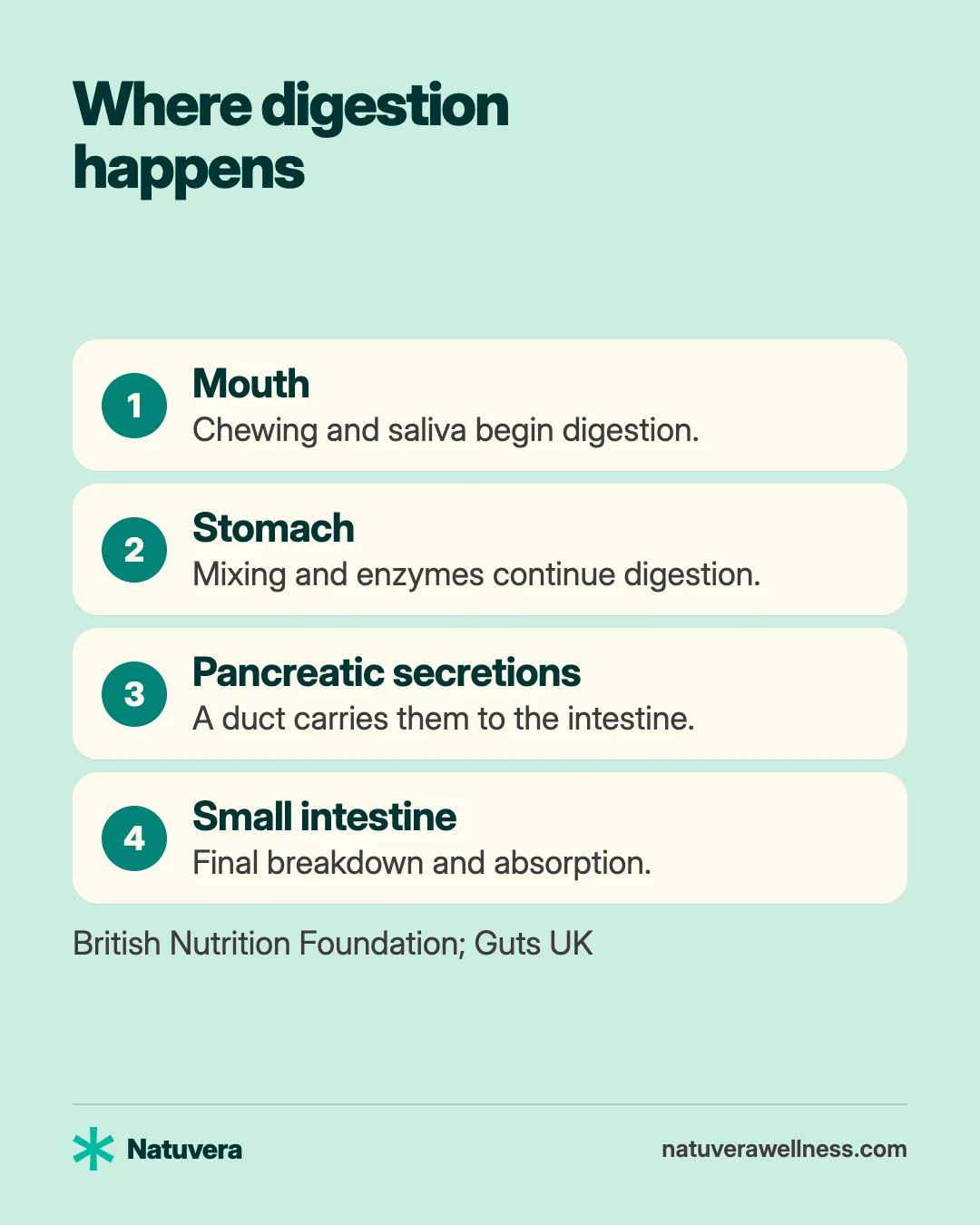
Digestion starts in your mouth, continues in your stomach and reaches its final stages in the small intestine, where nutrients are absorbed into the blood. 2
Mouth
Your salivary glands release saliva containing amylase. This begins the chemical breakdown of starch while chewing physically divides food into smaller pieces. 3
Stomach
The stomach contains the protein-digesting enzyme pepsin, as well as gastric lipase. Pepsin breaks proteins into shorter chains called peptides. Stomach acid and muscular mixing are other parts of digestion; acid is not itself an enzyme. 3
Pancreas
The pancreas sits behind the stomach and sends pancreatic juice through a duct into the duodenum, the first part of the small intestine. That juice contains digestive enzymes and bicarbonate, which neutralises acid arriving from the stomach. The pancreas makes enzymes in one place and releases them to act in another. 1
For the individual enzymes and their release, read what digestive enzymes the pancreas produces.
Small intestine
The lining of the small intestine has enzymes at its surface, known as the brush border. These include lactase, sucrase, maltase and peptidases. They carry out further stages of breakdown beside the intestinal cells involved in absorption. 3
What does each enzyme break down?
Different enzyme families act on different food components. Amylase acts on starch, proteases on proteins, lipase on fats and lactase on lactose. 13
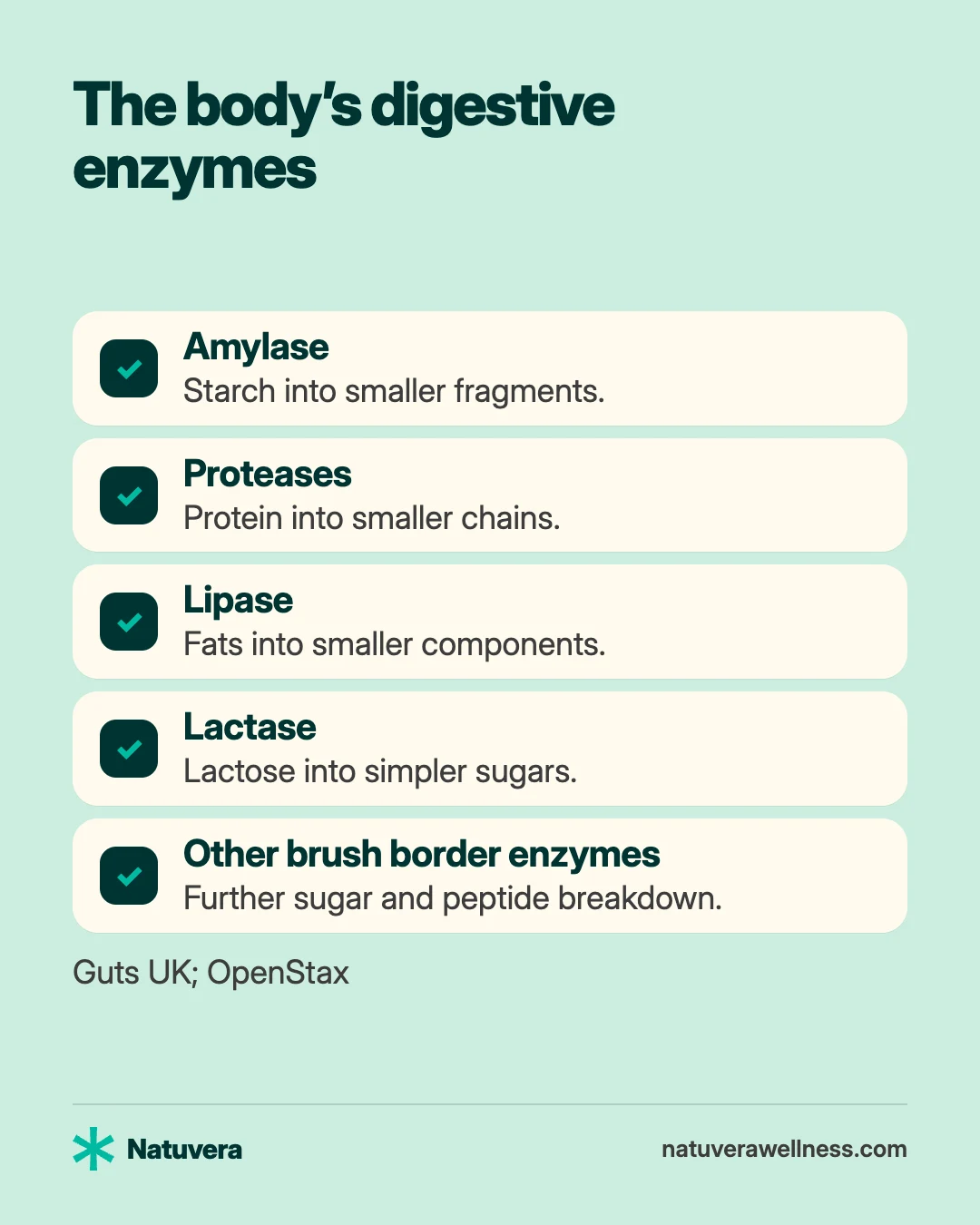
Amylase starts starch breakdown in the mouth and continues it through pancreatic amylase in the small intestine. Its products include smaller carbohydrate fragments. It does not complete every stage of carbohydrate digestion by itself. 4
Proteases are a family of protein-digesting enzymes. Pepsin acts in the stomach. Pancreatic proteases include trypsin and chymotrypsin, while intestinal peptidases carry out further breakdown of peptide chains. The final mixture includes amino acids and small peptides. 3
Lipase acts on fats. Pancreatic lipase breaks down triglycerides into fatty acids and monoacylglycerols, which are smaller fat components. The pancreas is an important source of this enzyme, although the mouth and stomach also contribute enzymes involved in fat digestion. 3
Lactase is made at the small intestine's brush border. It splits lactose, the sugar in milk, into glucose and galactose. Sucrase acts on sucrose, while maltase acts on maltose. These are separate steps from amylase acting on starch. 3
How are enzyme products sold in the UK?
Enzyme products are sold in the UK as food supplements. Government guidance places food supplements under food law and describes them as products intended to supplement the normal diet, sold in dose form. 5
When is medical advice needed?
Speak to your GP or pharmacist before considering a food supplement if you are pregnant, breastfeeding, taking medicines or have a pancreatic or bowel condition. Bring the complete label and your medicine list, so the discussion can address the actual ingredients. For ingredient specific safety information, read digestive enzyme supplement side effects and who should check first.
Common questions
Where are digestive enzymes made?
The body makes digestive enzymes in the mouth, stomach, pancreas and small intestine. Pancreatic enzymes travel through a duct to the small intestine.
What are the main types of digestive enzymes?
Amylase acts on starch, proteases act on proteins, lipase acts on fats and lactase acts on lactose. Brush border enzymes also include sucrase, maltase and peptidases.
Does the pancreas make digestive enzymes?
Yes. The pancreas sits behind the stomach and sends pancreatic juice, containing digestive enzymes and bicarbonate, through a duct into the first part of the small intestine.
General information about food and health, not medical advice. If you have symptoms or a medical condition, take any medicine or are pregnant, speak to your GP or pharmacist.
References
- Guts UK. Pancreatic Exocrine Insufficiency (PEI) and Pancreatic Enzyme Replacement Therapy (PERT). Undated. Read the source (accessed 12 November 2026).
- British Nutrition Foundation. How your gut affects your health. Undated. Read the source (accessed 12 November 2026).
- OpenStax. Anatomy and Physiology 2e: Chemical Digestion and Absorption: A Closer Look. 2022. Read the source (accessed 12 November 2026).
- Pancreapedia. Amylase. 2019. Read the source (accessed 12 November 2026).
- Department of Health and Social Care. Food supplements. 2018. Read the source (accessed 12 November 2026).