In short
- UK adults are advised to eat 30 g of fibre a day, with smaller amounts for younger children.
- NDNS 2019 to 2023 reports an average of 16.4 g a day for adults aged 19 to 64.
- SACN recommends obtaining fibre from a variety of foods.
In this article
- Is daily fibre intake different for women and men?
- How much fibre do people in the UK actually eat?
- What counts as fibre in the UK definition?
- Why a variety of foods?
- Which everyday foods belong on the shopping list?
- How do you read fibre information on food labels?
- Should you increase fibre all at once?
- When should you get advice?
- Common questions
- References
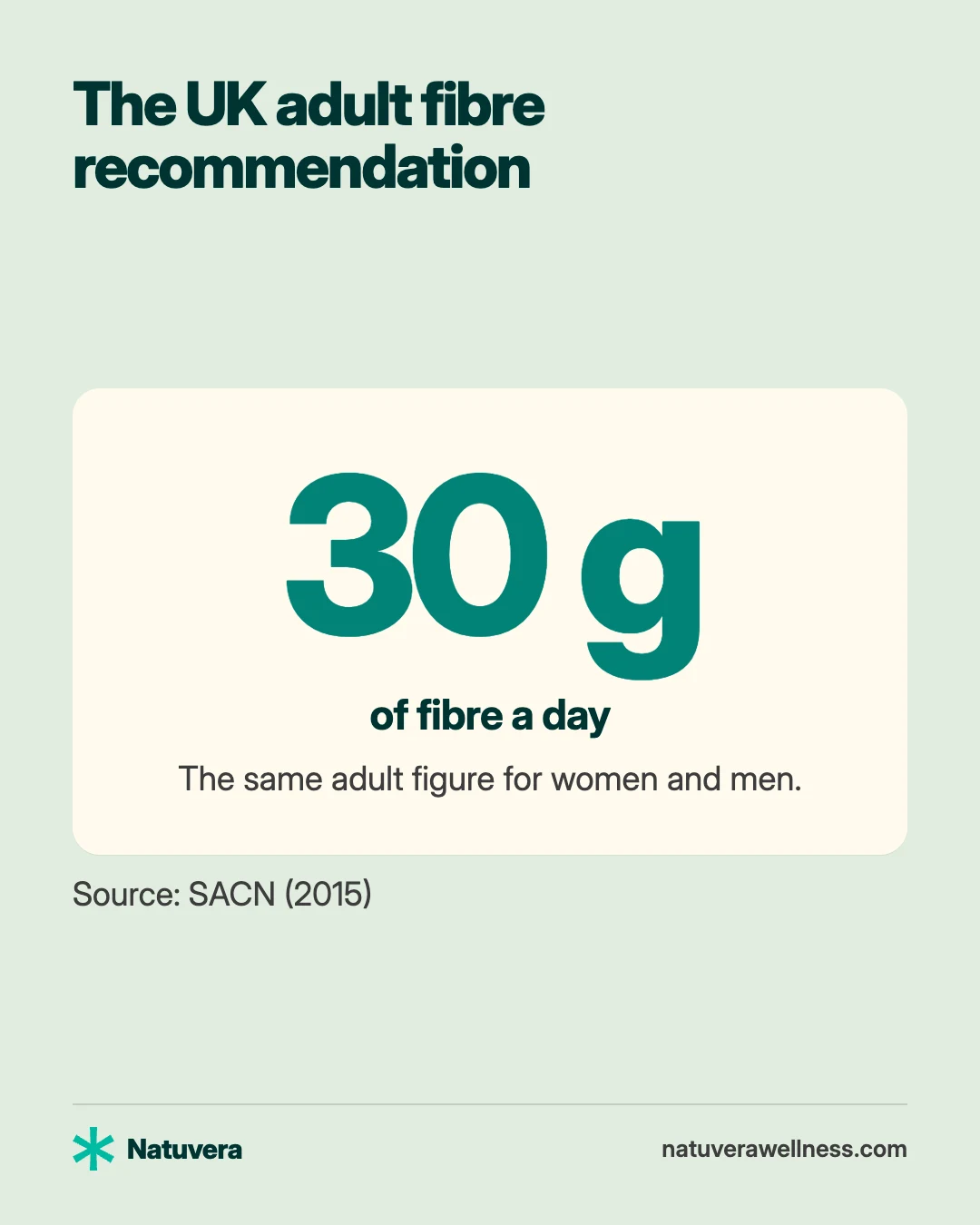
UK adults are advised to eat 30 g of fibre a day. This figure comes from the Scientific Advisory Committee on Nutrition (SACN) report Carbohydrates and Health (2015), published on GOV.UK, and is adopted in NHS and British Nutrition Foundation guidance. 123
| Age group | Recommended daily fibre intake |
|---|---|
| Under 2 years | No numerical recommendation in this report |
| 2 to 5 years | About 15 g |
| 5 to 11 years | About 20 g |
| 11 to 16 years | About 25 g |
| 16 to 18 years | About 30 g |
| Adults | 30 g |
The table follows SACN's age bands and population recommendations, including its separate entry for older teenagers. These are amounts of dietary fibre, not weights of food. 1
Is daily fibre intake different for women and men?
The UK adult recommendation is 30 g a day for both women and men. SACN sets an adult population reference value rather than separate male and female amounts, so the same UK figure applies when you search for recommended daily fibre intake for a woman. 1
How much fibre do people in the UK actually eat?
The National Diet and Nutrition Survey (NDNS) for 2019 to 2023 reports mean daily fibre intakes of 16.4 g for adults aged 19 to 64, 16.9 g for those aged 65 to 74, and 16.4 g for those aged 75 and over. It reports that 4% of adults met the recommendation. 4
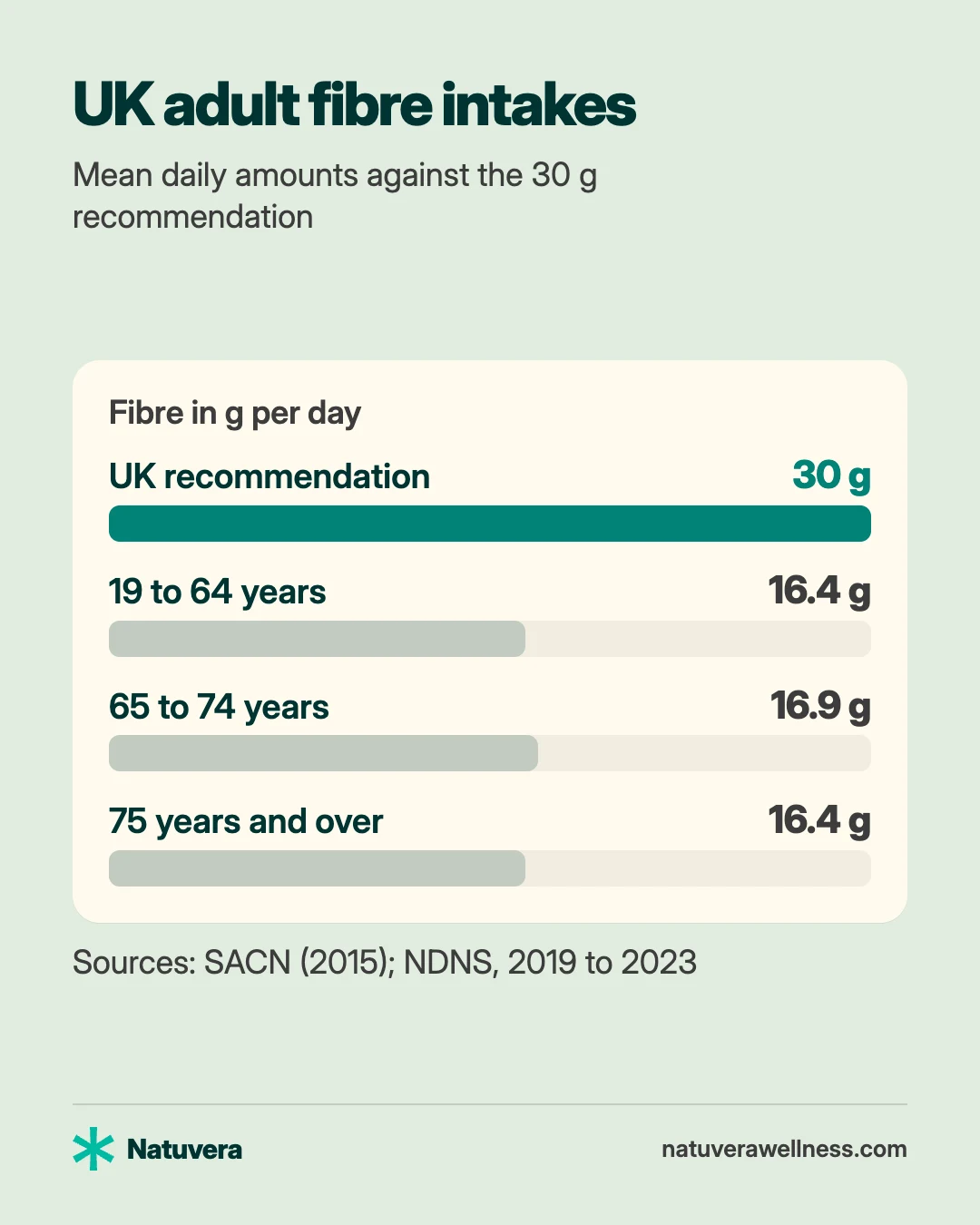
These are survey averages across age groups, not a reading of your own intake. The report covers people living in private households across the UK and records food and drink using online dietary recalls. Its results describe the survey period, not meals eaten on the day you read this guide. 4
You may also see the NHS page summarise adult intake as about 20 g a day. For the dated survey figures above, use the NDNS report, whose page was updated in November 2026. It warns that the move from paper diaries to online recalls means these results cannot be directly compared with previous survey years. The different figures alone are not evidence that intake has fallen. 24
What counts as fibre in the UK definition?
SACN's definition includes carbohydrates that are not digested or absorbed in the small intestine, made from at least three linked units, plus lignin. It specifies recognised AOAC analytical methods and requires accepted evidence of physiological effects for extracted or synthetic components to qualify as dietary fibre. 1
In everyday food terms, fibre comes in different forms. The British Nutrition Foundation describes soluble and insoluble types, including pectins and cellulose, and explains that the familiar split is a simplification. You do not need to classify every ingredient in your dinner to use the adult daily recommendation. 3
Our article on soluble fibre foods explains that distinction and gives examples from ordinary meals. Use it if you are trying to understand food lists that seem to put the same food in more than one category.
Why a variety of foods?
SACN recommends obtaining fibre through varied food sources. Its discussion distinguishes evidence about fibre within foods from evidence about isolated components. That is a reason to build variety into everyday meals rather than focus all your attention on a single food. 1
A useful way to apply that advice is to organise your next shop around meals you enjoy. Choose the breakfast you will actually make, a lunch that fits your working day and an evening meal you can prepare with the time available. Then decide where a different grain, some pulses or vegetables would fit. There is no need to invent a completely new menu before you start.
Which everyday foods belong on the shopping list?
NHS advice on starchy foods recommends wholegrain versions where possible and potatoes with their skins on. Examples include wholemeal bread, brown rice and wholewheat pasta. White bread contains less fibre than wholemeal or wholegrain versions, so the bread you buy regularly is a practical place to compare options. 5
For breakfast, choose between porridge and a wholegrain cereal according to what you like. At lunch, try wholemeal bread with a filling you already use. For an evening meal, think about whether brown rice, wholewheat pasta or a skin-on potato would fit the dish. These are possible menu choices, not a required daily combination. 5
For a fuller set of swaps, read how to increase your fibre intake. It includes food-based meal examples and a gradual approach, so you can choose a starting point without turning dinner into a calculation exercise.
How do you read fibre information on food labels?
The British Nutrition Foundation explains that fibre may appear as additional information on the nutrition panel. Back-of-pack values are shown per 100 g or 100 ml, and may also be shown per portion. There is no standard reference intake percentage for fibre on these labels. 6
First check which column you are reading. A per-portion value only describes the portion specified on the pack. If your bowl or slice differs, do not treat that value as an exact measurement of what you ate. For a straightforward comparison between similar foods, start with the same per-100-g column on each pack. 6
If you keep a food note, record the amount you actually serve alongside the label information, so the note reflects what was eaten rather than the pack's portion.
Should you increase fibre all at once?
The British Nutrition Foundation advises increasing fibre gradually and drinking plenty of fluids. A sudden change can bring bloating, wind or discomfort. You do not need to replace every familiar meal at the same time. 3
The NHS suggests having water with meals as a practical way to keep drinking. Start with a food change you can repeat, make drinks part of the meal, and review how the change fits before adding more. If you have been told to limit fluids or follow a particular diet, speak to your GP or pharmacist about your own instructions. 7
When should you get advice?
If changing your diet leaves you repeatedly uncomfortable, speak to your GP or pharmacist. Do not assume that persistent symptoms simply mean you need to keep adding fibre.
Use the age table as the reference, food labels as a guide to what you buy, and your usual meals as the starting point for changes. If you need individual dietary advice because of a medical condition, pregnancy, breastfeeding or medicines, speak to your GP or pharmacist.
Common questions
How much fibre should a woman have each day?
The UK adult recommendation is 30 g a day for women and men. SACN does not set separate male and female adult amounts.
Do children need the same amount of fibre as adults?
No. SACN gives about 15 g for ages 2 to 5, 20 g for ages 5 to 11, 25 g for ages 11 to 16 and 30 g for ages 16 to 18.
What counts as dietary fibre?
SACN includes carbohydrates that are not digested or absorbed in the small intestine, made from at least three linked units, plus lignin.
General information about food and health, not medical advice. If you have symptoms or a medical condition, take any medicine or are pregnant, speak to your GP or pharmacist.
References
- Scientific Advisory Committee on Nutrition. Carbohydrates and Health. 2015. Read the source (accessed 12 November 2026).
- NHS. How to get more fibre into your diet. 2026. Read the source (accessed 12 November 2026).
- British Nutrition Foundation. Fibre. n.d. Read the source (accessed 12 November 2026).
- Office for Health Improvement and Disparities. National Diet and Nutrition Survey 2019 to 2023: report. 2026. Read the source (accessed 12 November 2026).
- NHS. Starchy foods and carbohydrates. n.d. Read the source (accessed 12 November 2026).
- British Nutrition Foundation. Food labelling. n.d. Read the source (accessed 12 November 2026).
- NHS. NHS guidance on food and digestion. 2023. Read the source (accessed 12 November 2026).
- NHS. Bloating. 2026. Read the source (accessed 12 November 2026).