In short
- Preparations differ. Follow your own pack and ask a pharmacist if the directions are unclear.
- Check the amount per serving, liquid directions, timing, warnings and who the preparation is not for.
- Speak to your GP or pharmacist about medicines, medical conditions, pregnancy, breastfeeding or use for a child. Do not use a preparation if its label says it is unsuitable.
- The adult dietary fibre recommendation is about the whole diet, not an amount of psyllium.
In this article
There is no single way to take psyllium husk: directions vary among psyllium husk preparations. Follow the instructions on the pack you have, and speak to your GP or pharmacist if the directions are unclear. Government guidance also advises reading supplement labels and following their warnings and instructions. 1
What should you check on the label first?
Read the whole label, including the directions, ingredients and warnings, before deciding whether a preparation is suitable. Government labelling guidance says food supplement labels must include the recommended daily amount, a warning not to exceed it and the amounts of vitamins, minerals and other substances with a nutritional or physiological effect. 2
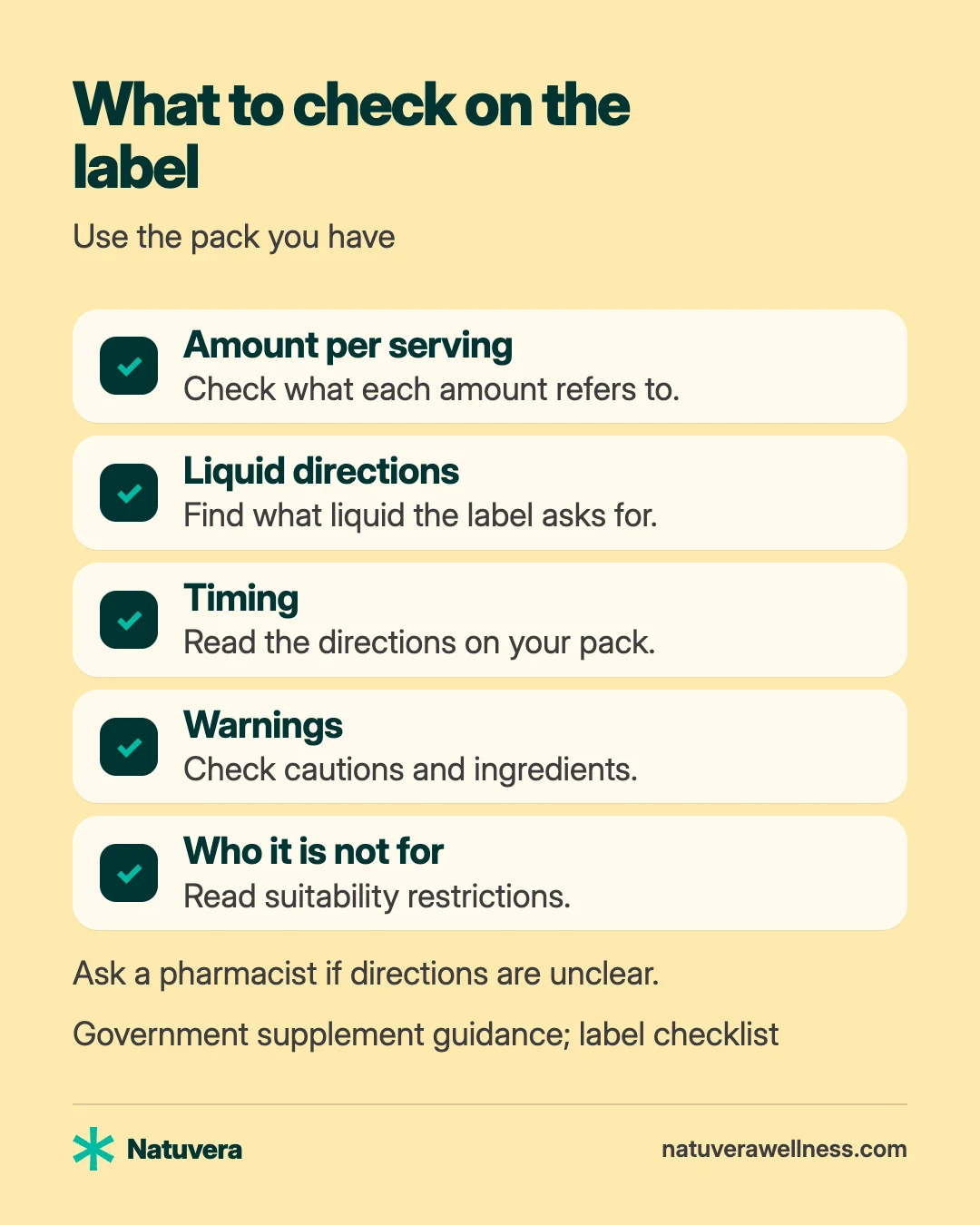
Use these questions to find the relevant information on your pack:
- Amount per serving: What does the label call a serving, and how much psyllium does that serving contain? Read the heading above the amounts, so you know whether they refer to a capsule, a serving or the recommended daily intake.
- Liquid: Does the label specify a liquid, and how much does it ask for? Look for the directions for the preparation you have, rather than borrowing a water quantity from another pack.
- Timing: What does the label say about when it is taken? Note any directions about food or other products for a pharmacist to check.
- Warnings: Which cautions, ingredients and allergens are listed? Read the warning panel as well as the front of the pack.
- Who it is not for: Does it exclude particular ages, pregnancy, breastfeeding or people with certain conditions? Check these restrictions before considering use. 2 1
If a label is missing, damaged or difficult to understand, ask a pharmacist to check it. Take the packaging with you or show clear photographs of every panel. This gives them the directions and ingredient list to work from, rather than just the ingredient name.
The sections below explain what to check on a label and when to ask for advice.
How much psyllium husk per day?
There is no single daily amount to apply across preparations. Look for the recommended daily intake on your own pack, alongside its serving information. Government guidance says to follow the label and not exceed the recommended amount. 1
A statement about how much an ingredient contains is different from a direction about how much of the preparation to take. If you cannot tell which information you are reading, ask a pharmacist to explain the label. Do not use directions for a medicine to calculate an amount for a supplement.
Is the adult fibre recommendation a psyllium amount?
SACN recommends an average population dietary fibre intake of 30 g a day for adults. This concerns fibre across the whole diet. It is not a psyllium amount and cannot be used to work out a number of capsules, spoonfuls or servings. 3
Why does the liquid information matter?
UK prescribing information for an ispaghula husk medicine warns that bulk-forming agents taken with inadequate fluid can cause choking or obstruction of the throat, oesophagus or intestine. This is a safety warning, not a preparation method for other products. 4
Check the liquid directions on your own label. If they are unclear, speak to your GP or pharmacist. If you have been told to restrict fluids, ask how the preparation's directions fit your existing medical advice before considering it. Do not change a prescribed fluid restriction yourself.
When should you take psyllium husk?
Follow the timing instructions for your own preparation.
If you take medicines, vitamins or other supplements, speak to your GP or pharmacist about possible interactions and timing for your specific preparation. The NHS medicine safety advice asks people to disclose these other products to their doctor or pharmacist. 5
Bring a list of what you take and the pack you are asking about. Include non-prescription products and herbal preparations. The question is about the combination you actually use, so keep that information together when seeking advice. 5
Who should speak to a GP or pharmacist first?
Speak to your GP or pharmacist before considering a psyllium preparation if you have swallowing difficulties or known bowel obstruction or narrowing. UK prescribing information lists swallowing problems, intestinal obstruction and abnormal narrowing of the digestive tract as contraindications for the ispaghula medicine it describes. 4
If you have a medical condition or take medicines, speak to your GP or pharmacist before considering a supplement. Government supplement guidance advises checking first in these circumstances. 1
If you have IBS or persistent bowel symptoms, speak to your GP or pharmacist before considering a supplement. If symptoms persist or worsen, seek medical advice.
Pregnancy, breastfeeding and children
If you are pregnant or breastfeeding, or considering a preparation for a child, check its label and speak to your GP or pharmacist. Do not use it if the label says it is unsuitable. Medicine suitability information does not establish whether a supplement is suitable.
When should you get medical advice?
If symptoms persist or worsen, speak to your GP. The following warning signs come from NHS pages.
For ingredient background, read what is psyllium husk?. For the separate safety discussion, see psyllium husk side effects.
Common questions
How much psyllium husk should I take per day?
There is no single daily amount across preparations. Follow the recommended daily intake on your own pack and ask a pharmacist if it is unclear. The adult dietary fibre recommendation is not a psyllium amount.
How do you use psyllium husk powder?
Preparations differ. Follow the instructions on the pack you have, and speak to your GP or pharmacist if the directions are unclear. Check what the label says about liquid and preparation.
When is the best time to take psyllium husk?
Follow the timing instructions for your own preparation. If you take medicines or other supplements, speak to your GP or pharmacist about what is suitable.
Can I take psyllium husk with other medicines?
If you take medicines, vitamins or other supplements, speak to your GP or pharmacist about possible interactions and timing for your specific preparation.
General information about food and health, not medical advice. If you have symptoms or a medical condition, take any medicine or are pregnant, speak to your GP or pharmacist.
References
- Department of Health and Social Care. Food supplements guidance, sections 7 and 8. 2026. Read the source (accessed 13 November 2026).
- Department of Health and Social Care. Food supplements, section 4: Labelling. 2018. Read the source (accessed 13 November 2026).
- Scientific Advisory Committee on Nutrition. SACN statement on expressing energy, fat and carbohydrate intakes and recommendations: Dietary fibre. 2025 (updated). Read the source (accessed 13 November 2026).
- Electronic Medicines Compendium. Ispaghula husk: UK summary of product characteristics, sections 4.3 and 4.4. 2021. Read the source (accessed 13 November 2026).
- NHS. Ispaghula husk: other medicines and herbal supplements. 2026 (last reviewed). Read the source (accessed 13 November 2026).
- NHS. Bloating. Publication year not stated. Read the source (accessed 14 November 2026).
- NHS. Constipation. 2023 (last reviewed). Read the source (accessed 13 November 2026).
- NHS. Ispaghula husk: side effects. 2026 (last reviewed). Read the source (accessed 13 November 2026).